From Visibility to Readability to Be Chosen in Travel-Planning Requests: Data, APIs and Visibility in AI Assistants
AI-readable destinations organise reliable, up-to-date information so assistants can understand places, compare experiences and support travel planning and booking.
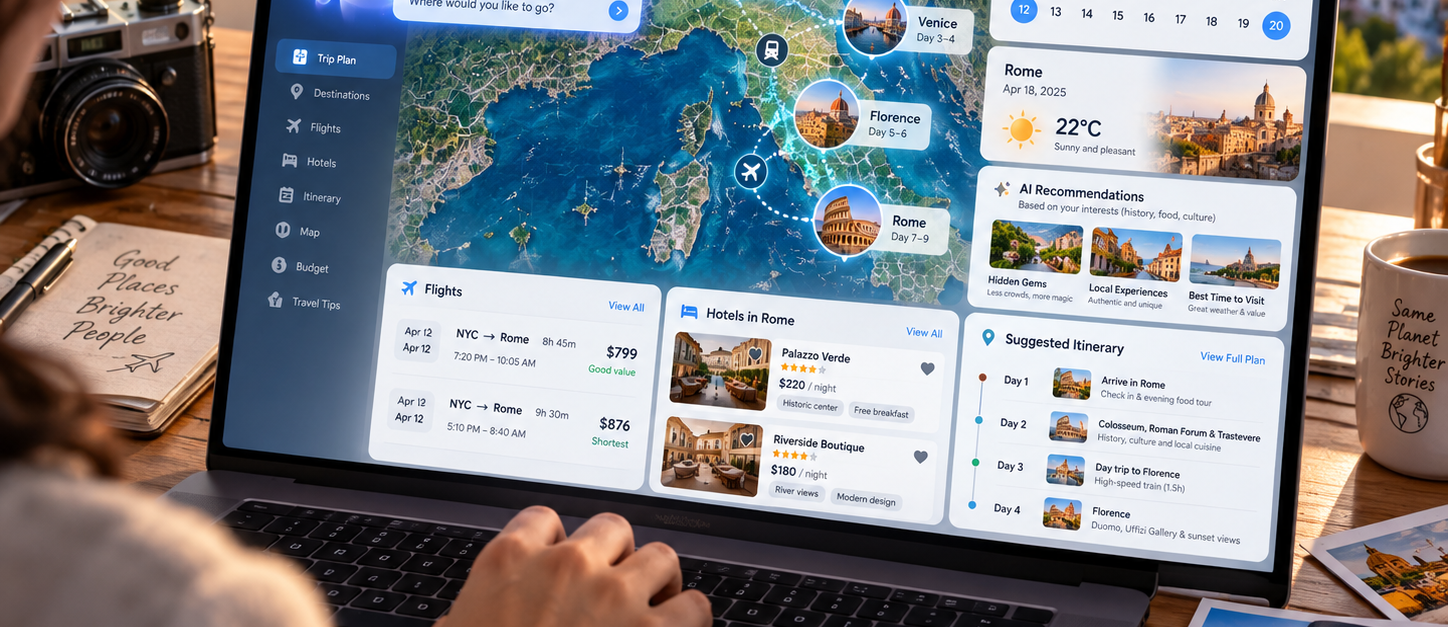
For years, a destination’s digital presence was built around one question: how can it be found by people organising a trip? Official websites, SEO, social media, maps and online guides addressed this need. AI assistants are changing the starting point. Travellers increasingly make comprehensive requests: four days in a European city, without a car, with children, alternating museums and nature, avoiding overcrowded areas and staying within a budget.
A request like this already contains almost the entire outline of the trip. The assistant must compare season, mobility, costs, accessibility, duration, crowding and compatibility between experiences. Google describes part of this process as query fan-out: a complex question is broken down into multiple parallel searches before an answer is provided.
For a DMO, the nature of visibility therefore changes. A page may describe a valley perfectly, yet leave crucial elements unresolved: how to get there, how long to stay, when to go, who it suits, what limitations it has and what can be combined on the same day. This gives rise to the idea of an AI-readable destination: a destination capable of turning content and data into knowledge that machines can find, connect, compare and use to make a choice.

AI-Readable Destinations: From Discovery to Booking
AI visibility is not a single problem. The first level is being found: accessible, indexable and technically readable content. The second is being understood: a place must become an entity with attributes and relationships. A museum, for example, is not just a page; it is a place with coordinates, opening hours, admission price, average visit duration, a collection, accessibility, nearby attractions and booking methods.
The third level is being chosen. An assistant that knows twenty museums must understand which are best suited to a family, an archaeology enthusiast or someone with two hours to spend near the station. Duration, audience, difficulty, atmosphere, cost, best time to visit, crowding, accessibility and opportunities for combining experiences become crucial information.
The fourth level is now transactional: being booked. Assistants are evolving into systems capable of checking availability and prices and completing actions. The chain therefore becomes: being found → being understood → being recognised → being chosen → being booked.

Building Access to Knowledge
The first infrastructure for AI tourism resembles good web architecture: stable URLs, readable HTML, semantic hierarchies, internal links, sitemaps, consistent language versions and up-to-date content. Every beach, trail, museum, market or winery should have a clear digital identity, linked to an address or geographical coordinates.
Structured data helps make these relationships explicit. Schema.org already provides types such as TouristDestination, TouristAttraction and TouristTrip, alongside Hotel, Event, LocalBusiness, Restaurant, Offer and GeoCoordinates. They are not a shortcut into AI answers: Google reiterates that no special markup is required for AI Overviews or AI Mode. Their value lies in making content semantically clearer.
In tourism, geography and time are especially important. Coordinates, distance, proximity, opening hours, seasonality, temporary closures and events are part of a destination’s information capital. Multilingualism also requires discipline: mixed-language pages or incomplete translations create ambiguity. Feeds and APIs then add an operational level: a page says that an exhibition exists, a feed communicates when it opens, and an API can check whether tickets remain.
From the CMS to the Destination Knowledge Graph
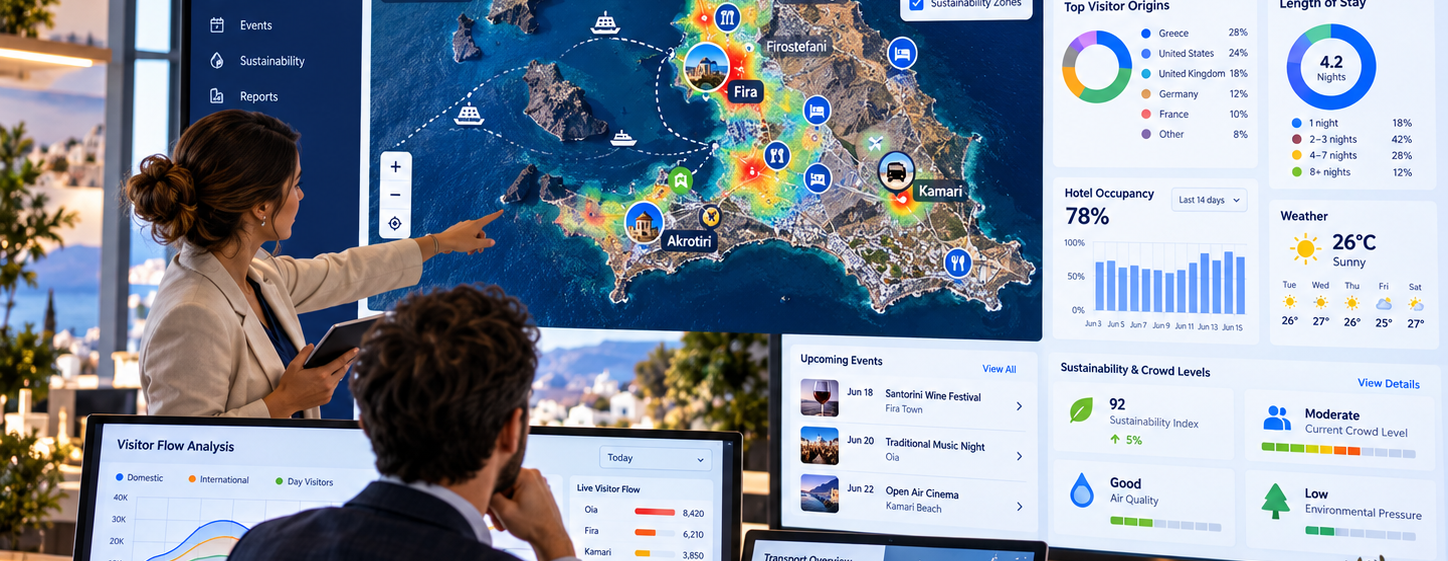
Many destinations have thousands of pages, but not necessarily a knowledge base. An assistant tasked with planning a day must reconstruct relationships often scattered across websites, PDFs and databases. The decisive transition is from the CMS to the Destination Knowledge Graph, where places, events, services and itineraries become connected entities.
A winery, for example, can be described not only through what it produces, but through coordinates, tour languages, tasting duration, booking, capacity, accessibility, parking, transport connections, seasonality and proximity to other places. At that point, AI can include it in a coherent itinerary.
The core areas of knowledge are relatively stable: identity, geography, time, audience, accessibility, cost, mobility, booking, constraints, relationships and last update. This granular knowledge constitutes the destination’s true knowledge capital. The internet already knows major monuments very well; the DMO, by contrast, knows the small museum that holds workshops on Saturdays, the trail that reopens in spring or the bus that reaches a village.
From Content That Inspires to Content That Informs Decisions
Tourism has learnt to generate desire through images, storytelling, creators and video. AI introduces another need: reducing uncertainty. A text describing a beach may be evocative; it becomes more useful for planning when it adds wind exposure, the best time of day, distance from parking, accessibility, facilities, crowding and nearby trails.
Alongside inspirational content, there is therefore a need for decision content built around the conditions that determine a choice: how long the experience actually lasts, when it works best, who it suits, what limitations it has, how much it costs and what alternative is available if it rains.
The logic becomes condition → possibility → consequence. If you have three hours, this combination is realistic; if you travel in winter, this experience retains its value; if you arrive by train, this neighbourhood reduces travel. For a DMO, the advantage lies above all in non-commodity destination knowledge: information difficult to find elsewhere because it comes from direct knowledge of the territory. Fewer interchangeable descriptions, more useful knowledge.

A Global Destination Speaks Multiple Cultural Languages
Translating a website is not enough to make it global. People from different markets may view the same place through different criteria. Language and culture intertwine with age, income, family composition, religion, travel experience and motivations.
The solution can be organised into two levels. The Global Knowledge Core keeps the facts unchanged: location, opening hours, prices, duration, transport connections, seasonality, accessibility, rules and availability. Around it, a Local Lens selects information relevant to an audience: halal dining, places of prayer, car-free mobility, shopping, privacy, sustainability, digital payments, family services or multigenerational needs.
Some topics remain essentially universal: coordinates, opening hours, prices, distances, weather, duration and access conditions. Others vary culturally: diet, religious practices, privacy, group composition, shopping, the meaning of luxury, attitudes towards sustainability and service expectations. The strategy must therefore maintain a single factual foundation and adapt how information is ordered and explored in depth. One truth about the destination, multiple ways of understanding it.
Translating keywords is not enough: intent localization is needed, studying the questions different audiences actually ask before making a choice. An effective methodology begins with a canonical source, analyses queries, analytics, reviews, contact centres, agencies and social search, connects questions to knowledge-base attributes and periodically checks results using prompts in the languages of priority markets. Language, market and persona must remain distinct variables, avoiding national stereotypes.

Each Type of AI Requires Different Information
Generative AI needs accessible, reliable and original content. Geographic AI works with coordinates, categories, opening hours, services and proximity. Trip planners add duration, sequence, transfers and compatibility between activities. Personalisation AI requires attributes relating to audience, interests, budget and accessibility. Multimodal AI uses images and video as information too, rather than solely as inspiration.
Agentic AI adds the decisive step: action. If a traveller asks it to organise three days, choose a hotel and book museums and restaurants, the system must be able to interact with websites and transactional systems. This is where accessible interfaces, structured feeds and APIs come into play.
A page communicates that a guided tour exists; an API can say that six places remain on Saturday at 11:30. Content generates interest, data enables comparison, and the API makes action possible.

From the Website to Data Infrastructure
No DMO directly holds all the data needed to describe a destination in real time. Opening hours, hotels, events, transport, trails and availability belong to different organisations. The tourism system is distributed, and its digital infrastructure must learn to be distributed too.
The concept of tourism data spaces arises from this need. In Europe, DEPLOYTOUR is working on the Common European Tourism Data Space to make tourism data more interoperable and shareable. A simple question such as “Can I reach this village by bus on Sunday and visit the museum before it closes?” already requires interaction between mobility and cultural data.
Alongside the portal, a Destination Data Hub can therefore emerge, supported by genuine data governance: who produces the data, who updates it, what the official source is, how often it is synchronised, which identifier connects different databases and which information can be redistributed.

Authority and Measurement
A destination’s digital identity also exists outside its official website: maps, museums, operators, universities, media, guides, reviews and platforms. A plurality of sources increases the depth of knowledge, but contradictions about fundamental facts create uncertainty. Name, address, coordinates, URL, opening hours and basic identity should therefore be consistent throughout the ecosystem.
Measurement changes too. Traditional ranking is not enough. Retrieval visibility, citation visibility, recommendation visibility and conversion visibility must be observed: does AI find the destination? Does it cite it? Does it recommend it for compatible intents? Does the recommendation generate traffic or bookings?
A DMO can create an AI Visibility Observatory, testing a stable set of prompts over time across different markets and languages. The aim is not to seek a fixed position, but to identify patterns: which destinations appear, which attributes are associated with them, which sources are used and which information remains invisible. The most interesting metric becomes share of recommendation.
Accuracy must be added to these metrics: being cited is not enough if the assistant returns outdated opening hours, an incorrect distance or attributes characteristics to a place that it does not possess. Monitoring must therefore also measure the quality of representation, identifying recurring errors and tracing them back to the sources that feed them. In this way, AI visibility also becomes a tool for information governance.
A Methodology for Becoming AI-Ready
The process can be organised in layers. It begins with an AI Destination Audit, which checks how the destination is represented and what errors or gaps emerge. This is followed by an Entity Map of places, events and services, then a Knowledge Layer containing the attributes needed for planning.
Structured Exposure distributes this knowledge through pages, structured data, maps, feeds and APIs. Decision Content answers travellers’ real questions; the Cultural Layer adapts relevance to languages and markets; the Live Layer connects opening hours, mobility, events, prices and availability to sources that can be updated.
The Authority Network keeps information distributed throughout the ecosystem consistent; the Transaction Layer connects knowledge to booking systems; the Measurement Layer monitors retrieval, citations, recommendations, accuracy and conversions. The result is not a destination “optimised for ChatGPT”, but a destination capable of providing quality information to any system that needs to understand it.
Local Knowledge as a Competitive Advantage
AI already has millions of descriptions of Rome, Paris, Marrakech or Tokyo. A destination’s advantage does not lie in adding yet another generic text, but in making available what it knows better than the internet: which coast stays sunny until late, when a museum offers a special tour, which bus connects two villages, how long a trail actually takes, which experiences work with young children or what becomes impassable after heavy rain.
This knowledge is often scattered among people, operators and institutions. Structuring it turns it into an infrastructure capable of producing more relevant, less standardised trips that are better distributed across the territory.
The sequence remains simple: being found → being understood → being recognised → being chosen → being booked. Behind every step lies the same raw material: reliable, up-to-date and connected knowledge.
The digital destination of the next decade will look less and less like a catalogue and more and more like a living knowledge infrastructure, capable of speaking to people through stories and to machines through data, relationships and interfaces. The quality of the choice will depend on the quality of the knowledge AI finds.

Sources
Google Search Central AI Overviews, AI Mode, query fan-out, SEO and content for AI
OpenAI Help Center OAI-SearchBot, ChatGPT Search, referrals and accessibility for agents
Schema.org TouristDestination, TouristAttraction, TouristTrip and structured data
Google Maps Platform / Places API places, proximity, place data and AI summaries
DEPLOYTOUR / European Tourism Data Space interoperability and sharing of tourism data
Google Search Console measuring visibility in generative experiences
Academic research on GEO and Generative Search relevance, authority and variability of results
Studies on cross-cultural tourist behaviour differences between markets, motivations and information seeking
Research on Muslim travel and Chinese outbound travel cultural needs, services, trust and travel motivations