A Country of Changing Horizons
Morocco cultural tourism extends beyond medinas and dunes, connecting living craftsmanship, contemporary design, modern cities and landscapes shaped by water and community knowledge.
In Morocco, just a few hours of travel are enough for the light to acquire a different quality, architecture to adopt different materials and vegetation to thicken or disappear. The ocean enters the cities with the smell of salt and fish unloaded at the ports; inland, the mountains hold the snow, while beyond the Atlas the earth turns ochre, palms follow the water and space takes on the sparseness of the Sahara.
These transitions precede the images that have made the destination famous: medinas, riads, souks, imperial cities, kasbahs and dunes. Powerful fragments of a far more varied geography.
Morocco’s cultural fabric has emerged from centuries of migration, trade and cultural exchange. The Mediterranean, sub-Saharan Africa, the Arab world, Amazigh cultures, Andalusia and Europe have left traces that have become part of its architecture, language, cuisine, music and ways of living.
Alongside monumental heritage, craft techniques, recipes, textiles and rituals live on, passed down and transformed in workshops, markets, celebrations and building practices.
This continuity feeds a vibrant contemporary scene. Zellige is reinterpreted by international design, tadelakt and raw earth return to discussions of climate-responsive architecture, while museums and foundations connect Marrakech, Rabat and Casablanca with African and global art scenes.
Marrakech, the Sahara and the imperial cities remain extraordinary entry points, but gain depth within a map of coasts, modern cities, mountains, forests, agricultural valleys and oases. Travel changes perspective by following these transitions.
A Country of Thresholds: Africa, the Mediterranean, the Atlantic
Morocco belongs to Africa, faces the Mediterranean and extends its relationship with the Atlantic over thousands of kilometres. Europe is separated by only a few kilometres of sea; to the south and east lie Saharan geographies and historical connections with West Africa.
These directions have produced cultural overlaps: what arrives from elsewhere is absorbed, modified and returned with a Moroccan character.
In the north, the Rif descends towards the Mediterranean through green mountains, forests and bays. Andalusian influence remains recognisable in architecture, music and decorative arts.
Tétouan preserves this legacy in its white medina and traditions of embroidery, woodwork, ceramics and metalwork, developed through migrations from the Iberian Peninsula.
Tangier, meanwhile, lives within the tension of the Strait, where the European coast appears on clear days. Merchants, diplomats, artists and writers have built a cosmopolitan city, now transformed by infrastructure, logistics and cultural centres. Its role as a gateway between Europe and Africa takes on new forms.
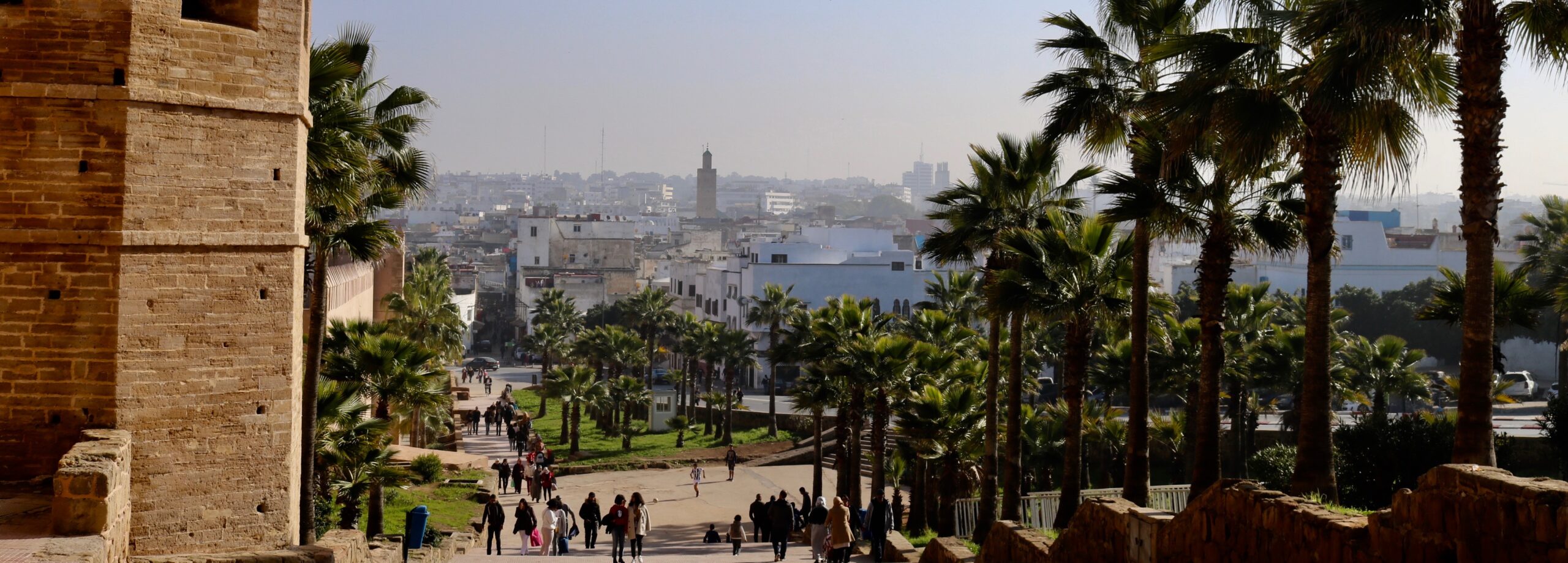
Along the Atlantic, Rabat presents a measured relationship between history, institutions and modern architecture: the Kasbah of the Oudayas overlooks the Bouregreg, while twentieth-century districts and cultural spaces develop beside the historic city.
Casablanca takes this dimension to a metropolitan scale. Art Deco, modernism and neo-Moorish architecture coexist in a productive port city, where European elements are transformed through local materials and ways of living.
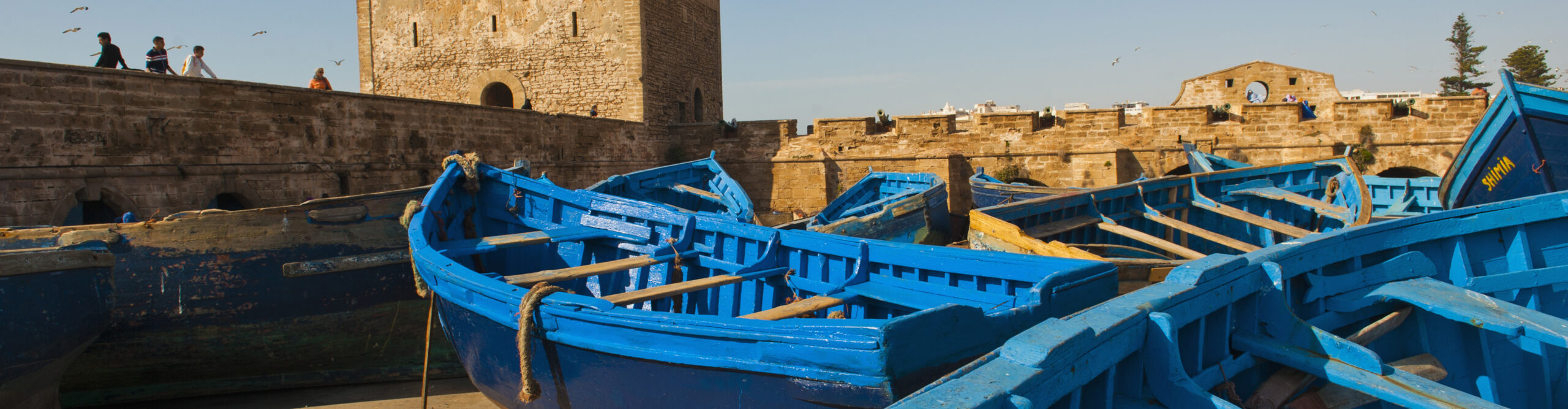
Essaouira introduces another rhythm. The wind brings the ocean into the medina, and the port’s history interweaves sub-Saharan routes, a Jewish-Moroccan presence and Gnawa culture.
Leaving the coast, agricultural plains, mountains, valleys and oases alter materials, crops and rhythms of life. Morocco’s unity takes shape through differences still legible in the landscape.

The Cities: Many Ways of Being Urban
The medina occupies a central place in the imagery of Morocco. Alleys, courtyards, workshops, mosques, fondouks and markets form complex urban organisms, built around relationships between public space, commerce and domestic life that differ from European ones.
The urban landscape, however, extends beyond this form. The cities tell of different eras and aspirations: Mediterranean connections, modernisation, a concentration of crafts, international reinvention and an oceanic vocation.
Tangier and Tétouan: Mediterranean Morocco
In Tangier, geography enters the urban experience. From the port, streets climb and narrow towards the kasbah, where the gaze returns to the Strait.
The cosmopolitan past emerges in cafés, villas and buildings from the international period. Today it coexists with port and logistics expansion, new districts and infrastructure that have restored the city’s economic importance within western Mediterranean networks.
Tangier acquires a dual pace: terraces, markets and old hotels survive alongside a metropolis integrated into major production and trade networks.
Tétouan has a more intimate character. Its relationship with Andalusia emerges in white houses, courtyards and traditions of carved wood, ceramics, embroidery and metalwork.
Walking slowly through the medina reveals, in its workshops, craftsmanship whose cultural and social function predates tourism.
Rabat and Casablanca: Modern Morocco
Rabat has the measured rhythm of a layered capital. The medina coexists with the main urban axes of the twentieth century; the Kasbah of the Oudayas overlooks the Bouregreg, beside gardens, museums and institutional buildings.
Protectorate-era architecture has been superimposed on the historic fabric without erasing it, creating a sequence in which different eras converse.
Casablanca takes this experimentation to a larger scale. Having grown around the port, industry, commerce and internal migration, it has become the country’s great economic engine.
Between the 1920s and the 1960s, Moroccan and European architects experimented with Art Deco façades incorporating local motifs, modernist buildings attentive to ventilation and shading, and housing developments intended to respond to demographic pressure.
Cinemas, hotels, covered markets and residential complexes allow modernity to be read on their façades. Property pressure, restoration, demolition and infrastructure continue to reshape them: Casablanca tells the story of Morocco as it changes.

Fès and Marrakech: Two Ways of Inhabiting History
In Fès, the density of time emerges through sounds, smells and gestures. The sound of hammered metal reaches us before the workshops, cedar mingles with spices, mules pass through narrow alleys and discreet doors open onto courtyards of zellige, carved wood and stucco.
Mosques, madrasas, fondouks and workshops form a system in which the monumental and productive city still partly coincide. Potters, tanners, carpenters and weavers preserve techniques that require long apprenticeships: heritage includes the passing of knowledge between generations.
Marrakech has transformed local materials and architecture into an international language. The riad has entered global hospitality, tadelakt and zellige interior design, while fashion, art and gastronomy have broadened the city’s image.
Museums, foundations, galleries and hotels reinterpret Moroccan repertoires, attracting artists and designers from many countries.
Exposure to tourism has transformed neighbourhoods and economies, generating tensions. Yet within this pressure, significant transitions can be observed: from craft to design, from the traditional house to contemporary hospitality, from the private collection to the museum.

Essaouira: The Cultural Atlantic
In Essaouira, the wind passes through gates and ramparts, while the ocean remains present in the sound of waves and the salty smell.
The port retains the everyday life of boats, nets and the fish market. The medina tells of exchanges between Muslim and Jewish communities, European traders and African routes.
Gnawa music brings together part of this history: sub-Saharan rhythms and rituals have intertwined with Moroccan culture, producing an international language.
Studios, galleries, festivals, surfing and slow tourism have expanded the narrative without separating it from the port’s memory.
These cities form a geography of differences: the Mediterranean, Andalusia, modernism, Africa and the Atlantic emerge with varying intensity. Each city adds a layer to the country’s image.
Beyond the Cities: Mountains, Ocean, Oases and Desert
Leaving the cities, distances acquire weight. Roads cross plains and climb towards mountain passes; houses become sparser, and travel adopts a rhythm dictated by geography.
The Atlas shapes climate, agriculture and settlements. In winter, snow-covered peaks appear from Marrakech; just a few hours separate the city from valleys where watercourses cut into the rock and villages follow the slopes.
In the High Atlas, terraced fields, walnut and apple trees and Amazigh villages form a landscape of adaptation. Earth, stone and wood take on the colour of the mountains, until the houses almost disappear into the rock face.
Aït Bouguemez, the Happy Valley, opens into an agricultural expanse between peaks over three thousand metres high. The paths make relationships between crops, animals and altitude legible. The M’Goun UNESCO Global Geopark adds a history of millions of years through gorges, rock strata and fossils.
Walking thus crosses geological, agricultural and everyday timescales.
In the Anti-Atlas, the mountains become dry and sculptural. Around Tafraoute, masses of granite emerge among almond trees and palms, within a palette of ochre, pink and grey.
The igoudar, fortified communal granaries on elevated ground, tell of a communal organisation: cereals, documents and family possessions were kept in shared structures. The mountain becomes a social system.
The Atlantic changes character towards the south. Beyond the wind of Essaouira come cliffs, little-visited beaches, ports and fishing villages. Fish is sold or cooked near the boats; the rhythm is made of salt, nets and tea served before the horizon.
At Khnifiss, a lagoon penetrates between dunes and arid surfaces: ocean, wetlands and desert coexist, providing a stopping place for migratory birds.
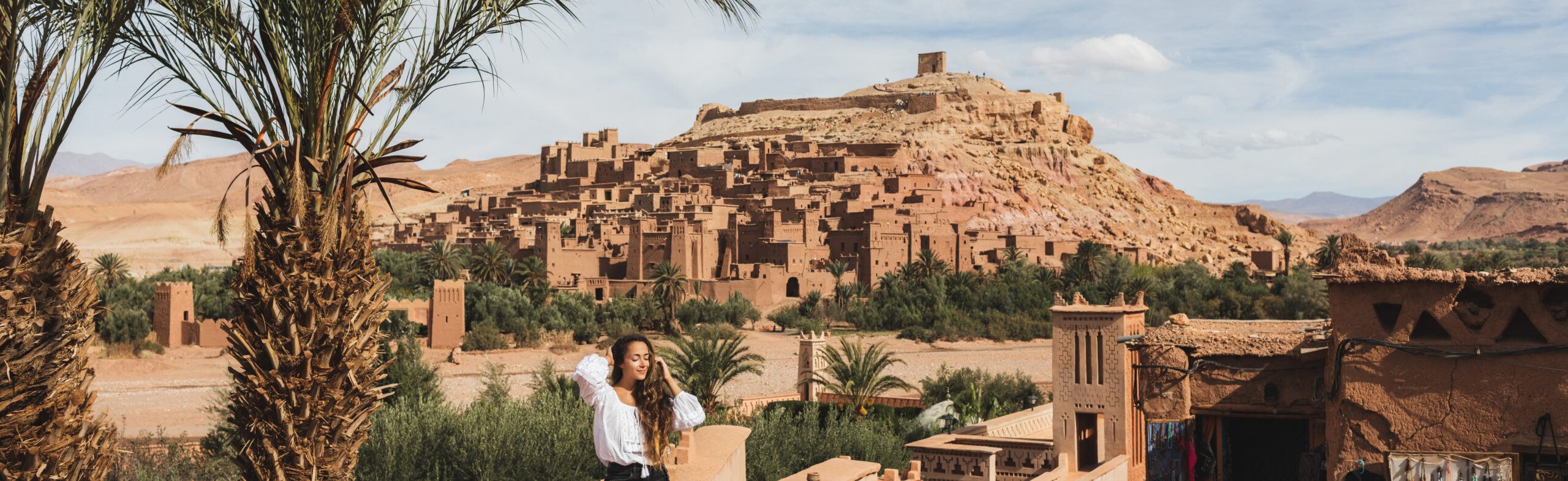
Beyond the mountains appear the oases, sophisticated systems of water, agriculture and shade. Palms protect fruit trees and crops; canals distribute water, and earthen houses keep interiors cool.
In the Drâa and Dadès valleys, greenery follows the water between kasbahs and rock faces. At Figuig, palm groves, ksour and hydraulic systems tell of centuries-old knowledge.
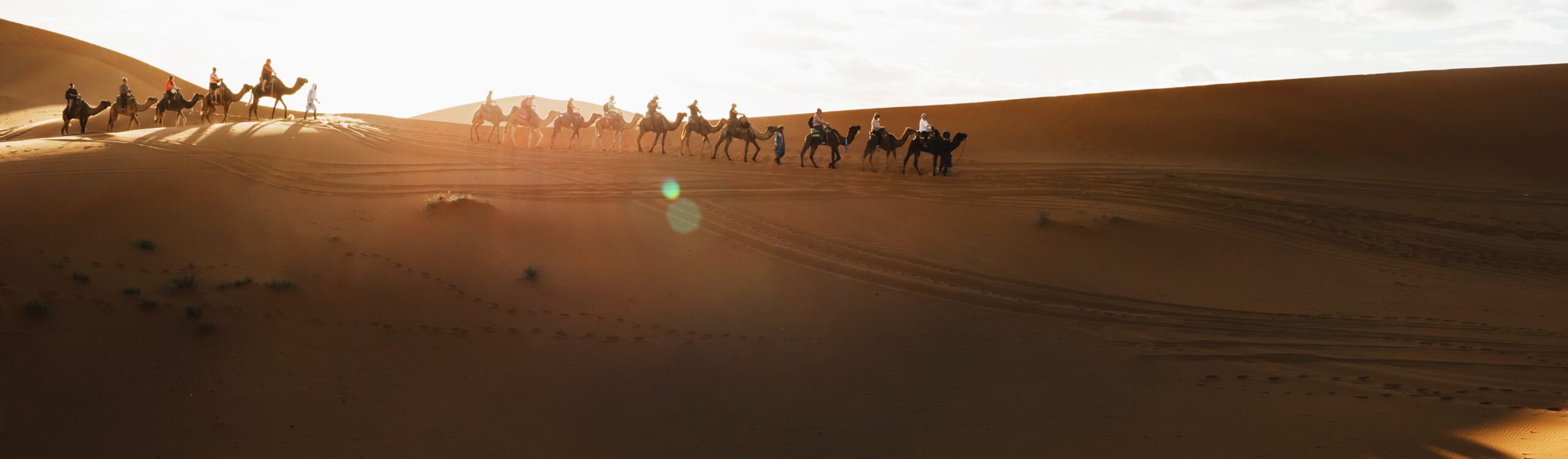
The Sahara arrives gradually: rocky plateaus, gravel and dunes. Merzouga and Erg Chebbi have made this image famous, from morning ochre to sunset copper. In the dark, distances become uncertain, sand absorbs sound and the sky gains depth.
The destination appears as a sequence of connected ecosystems: mountains that retain water, valleys that distribute it, oases that organise its use and coasts open to ocean routes.
Living Heritage, Craftsmanship and New Moroccan Design
In a workshop in Fès, an artisan repeats a gesture until a fragment of zellige takes shape. Stars, diamonds and polygons are placed together with their decorated sides facing down; only at the end is the mosaic turned over.
That patience tells of a relationship with materials. Cedar, clay, wool, brass, leather and raw earth span centuries, continuing to generate objects and spaces.
In the souks, hammers, looms and tadelakt surfaces reveal a chain of skills, time and materials linked to specific territories.
Contemporary design has opened new spaces for this culture. In Marrakech, riads, hotels and residences have transformed traditional materials into a vocabulary of courtyards, fountains, pierced metalwork, rugs and ceramics.
International diffusion risks separating the style from its cultures of origin. The most interesting projects instead maintain continuity between technique, material and function, involving artisans and leaving the irregularities of the hand visible.
Architecture returns to raw earth, courtyards, thick walls and ventilation for climatic reasons too. Centuries-old solutions regulated temperature and light before mechanical air conditioning.
At the Musée Yves Saint Laurent Marrakech, Studio KO uses brick in a pattern that evokes a textile. Nearby, the Jardin Majorelle creates a language of vegetation, light and intense blue.
The MACAAL, Museum of African Contemporary Art Al Maaden, places Marrakech within an African perspective through painting, photography, installations and video.
In Rabat, the Musée Mohammed VI d’Art Moderne et Contemporain tells of emancipation from colonial academic models, an interest in calligraphy, Amazigh culture and folk arts, and the emergence of individual artistic languages.
Fashion moves through the same tension: the caftan remains ceremonial while designers alter its proportions, fabrics and decoration.
Amazigh rugs preserve regional techniques and patterns, sometimes linked to genealogies, protection or the weaver’s imagination. International demand takes them from villages to apartments in major cities.
Industrial copies and simplification can impoverish them; traceability and remuneration for labour can instead make design a means of economic continuity.
Couscous, tajine, bread, argan and pastilla also tell of territories and agricultural systems. Young chefs reinterpret this memory, bringing local ingredients back to the centre of a dialogue with Africa, the Mediterranean and the Middle East.
Between market, museum and contemporary hotel, materials and skills change context. Tradition ceases to be scenery when it returns to functioning as a language capable of evolving.

Five Experiences Beyond the Most Predictable Routes
Morocco’s great images can conceal how much territory remains to be explored. Time, detours and guides able to interpret places lead towards broader stories, accessible through a building, a trace in the rock or an irrigation system.
Reading Casablanca Through Its Architecture
Looking up towards balconies, porticoes and façades, Casablanca reveals Art Deco, neo-Moorish languages, functionalism and modernism. UNESCO describes it as a crossroads of influences and a laboratory for twentieth-century architecture and urban planning.
A guided route makes visible zellige in modernist façades, cinemas, entrance halls and climate-responsive solutions. Casamémoire organises visits, trains guides as cultural mediators and sometimes opens buildings that are difficult to visit.
The city becomes a three-dimensional archive: within a few streets, the era and the idea of modernity change.

Walking in the Footsteps of Dinosaurs in the Atlas
In Aït Bouguemez, the morning begins among fields and villages; a red rock face then takes us back around 150 million years.
The M’Goun UNESCO Global Geopark preserves Late Jurassic footprints. Ibaqualliwn documents sauropods and theropods; Iouaridène holds one of the geopark’s largest palaeontological concentrations. Guided visits support a geological reading of the sites.
Among houses and crops appears the passage of animals that lived before those peaks acquired their present form. A depth of time difficult to convey in a photograph.
Climbing to the Igoudar of Amtoudi
At Amtoudi, in the Anti-Atlas, the palm grove traces a green strip beneath fortified granaries almost merged with the mountain.
Climbing to the agadir of Id Aïssa, the oasis shrinks and the building reveals its complexity. The igoudar stored food, valuables, documents and weapons, serving as lookout points and places of refuge. The Moroccan Ministry of Culture identifies Id Aïssa and Agadir n’Ugellu as representative examples of granaries on rocky spurs.
Cells, doors and locks tell of individual property protected by a collective institution: preserving resources became a shared system.
Following the Journey of Water in the Oasis of Figuig
Figuig requires a detour towards eastern Morocco. Seven ksour emerge in the palm grove, between arid mountains and a border that has accentuated its isolation. The oasis is on UNESCO’s Tentative List and is recognised by the FAO, together with the surrounding pastoral territory, as a Globally Important Agricultural Heritage System.
Moving through it by following the water reveals underground khettara, reservoirs and canals that irrigate by gravity. Rights are traditionally measured in units of time; maintenance involves communal organisation.
The FAO describes a technical and social heritage built around a scarce resource. Beneath the palms, fruit trees and crops reveal a balance continually maintained: a lesson in the ability to inhabit aridity.
Where the Sahara Enters the Atlantic: Khnifiss
Between Tan-Tan and Tarfaya, vegetation thins and the wind arrives without obstacles. Then water appears.
Khnifiss brings together ocean, wetlands, dunes and desert. The protected area indicated on UNESCO’s Tentative List reaches approximately 60,000 hectares, with different habitats within a Saharan environment.
The Moroccan National Tourist Office highlights hiking and nature observation; the lagoon is important for migratory birdlife.
The pace of travel is slow: walking, watching birds from a distance, sensing salt mingling with dust. Khnifiss adds the geography of an Atlantic advancing into the Sahara.
For the Travel Trade: Designing Morocco Beyond the Icons
In 2025, Morocco welcomed 19.8 million visitors, an increase of 14%, reaching 138 billion dirhams in tourism revenue. The Italian market grew by 21%. In the first eight months of 2026, arrivals reached 14.1 million, an increase of 4.5%.
In the first half of 2026, Italian arrivals increased by 6%; overnight stays grew by 23% in Ouarzazate, 20% in Rabat, 11% in Casablanca and Agadir, and 10% in Tangier. Growth increasingly extends to destinations beyond the established hubs.
Marrakech retains its emotional appeal, Fès its cultural centrality, Agadir its seaside vocation and Merzouga its Saharan recognisability. Around them lies material for programmes aimed at repeat visitors, small groups, independent travellers, premium clients and specialist interests.
The Tourism Roadmap organises product segments around city breaks, culture, nature and trekking, ocean, seaside, desert and oases, and business tourism, complemented by gastronomy, crafts, festivals, sustainability and alternative hospitality. The offering is conceived through experiences that can be combined.
Architecture can connect Casablanca, Rabat and Tangier; material culture can begin in Fès and reach textile communities in the Middle Atlas. Marrakech opens towards M’Goun and the High Atlas; Essaouira towards Agadir, Mirleft and the southern ocean. Figuig, Amtoudi and Khnifiss require slower programmes.
Connectivity supports this evolution. In 2025, airports exceeded 36.3 million passengers, an increase of 11%. For summer 2026, the ONMT had contracted 7.74 million seats, 13% more; in the first half of the year, 52 international routes were launched.
Al Boraq connects Tangier and Casablanca; work continues on the Kénitra–Marrakech high-speed line. Once completed, the project envisages Tangier–Marrakech in 2 hours and 40 minutes and Casablanca–Marrakech in approximately 1 hour and 15 minutes, within the railway programme leading up to 2030.
A more efficient axis facilitates north-to-south journeys from Tangier through Rabat and Casablanca, then Marrakech and the Atlas. Different entry and exit points allow stays to be distributed across regions.
Climatic variety also allows the product to be adapted to temperatures, agricultural seasons, festivals and mountain conditions.
Growth entails a commercial responsibility. Communities, workshops, water systems and fragile environments lose value if standardised. Quality will depend on guides, group size, time devoted to encounters and local remuneration.
A workshop becomes a key to the territory when the route explains materials, techniques, transmission and markets. The same applies to palm groves, agadir, kasbahs and geological sites.
The major commercial opportunity could develop around a second Morocco, for those returning with a different question: twentieth-century architecture, regional cuisine, Amazigh routes, African art, trekking, music and oasis cultures. Specialist programmes can extend stays and distribute benefits to less-visited territories.
With the target of 26 million visitors by 2030, value will also depend on distributing growth across space and time.
For those designing travel, the opportunity lies in moving from icons to connections: architecture and craftsmanship, mountains and cuisine, oases and water, coasts and African memory. The itinerary becomes a narrative.

Morocco After Morocco
On returning, images remain that are difficult to bring within a single definition: Tétouan’s white façades, traffic beneath Casablanca’s modernist buildings, the hammers of Fès, Essaouira’s wind, red earth, palm groves and the silence of the dunes.
Each territory holds a grammar and converses with the others. A zellige geometry reappears on a contemporary façade, a kasbah material enters new architecture, an African tradition enters festivals. Mountain water feeds oases, caravan tracks meet airports, ports still look towards the two seas.
Contemporary Morocco takes shape within these transitions.
Infrastructure, hospitality and museums accelerate transformations; Rabat, Casablanca and Tangier gain prominence, while the value grows of territories where travel retains slowness and direct relationships.
Success brings resources, but makes experiences replicable: riads, rugs and tented camps become global languages. Quality will depend on keeping their connection to their places of origin legible.
For travellers, this means moving from images to relationships. A medina changes through its trades, an oasis through water distribution, an earthen house through climate and materials. Casablanca becomes comprehensible through the ideas of modernity that shaped its neighbourhoods.
Luxury too finds a measure in depth: time, access and the quality of encounters can outweigh material exclusivity. Visiting a workshop, crossing a village with someone who lives there or reading a building with an architect restores a personal dimension.
Amazigh, Arab, African, Andalusian, Mediterranean and Jewish-Moroccan cultures continue to emerge in ways of living, cultivating, cooking and celebrating, in dialogue with design, art and a transformed society.
Africa, the Mediterranean and the Atlantic become cultural directions. The thread connecting worlds close in space and different in atmosphere is the ability to absorb, preserve and transform influences.
The Morocco that remains in memory resembles doors opening onto different landscapes, each capable of changing our understanding of the previous one.
Passing through them reveals the country’s most contemporary dimension: a crossroads still in motion.

Sources
Ministero del Turismo del Marocco — data, roadmap and 2030 targets
Observatoire du Tourisme — tourism flows and performance
UNESCO — heritage, creative cities, Casablanca, Figuig, Khnifiss, M’Goun
FAO – GIAHS — oases and traditional agricultural systems of Figuig
Casamémoire — modern architecture in Casablanca
MACAAL / Fondation Nationale des Musées — contemporary art and museums
Musée Yves Saint Laurent Marrakech — design and architecture
ONDA / ONCF — airports, connectivity and high-speed rail
Visit Morocco — territories, outdoor activities and destination experiences